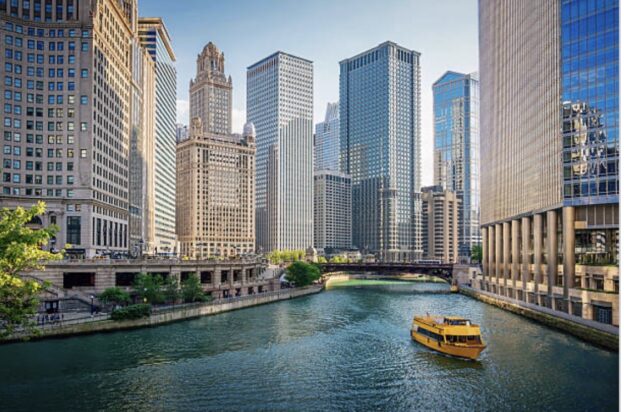
The idea for a trip to Chicago came up after friends of ours started asking where our next trip would be. We thought about the options and my partner suggested we travel domestically after having travelled internationally.
How about Chicago? He said. He had been there professionally but never with enough time to see too much of it. And always with the curiosity to see more. There was so much more to explore.
I had been to Chicago on a cross country road trip of America with my family as a child (more on that later). So, I was open to the idea. From Boston it’s a 2 hour flight, with a one-hour time difference. We blocked a week off after Memorial Day weekend, from May 27th through June 4th. The weather would be nice. We would not yet be in the height of the tourist season. We wouldn’t be missing too much on Cape Cod. And neither of us had any other obligations in that time frame.
And so, the research began. Once the flights were booked. Where should we stay?
Where to Stay in Chicago: A Considered Guide to the City’s Finest Hotels
Chicago is not a city that does anything halfway. Its architecture is the most ambitious in America. Its restaurant scene rivals any on the continent. And its hotels — particularly at the top of the market — reflect that same commitment to doing things properly, at scale, with conviction. The question isn’t whether you’ll be well-taken care of. The question is: what kind of well-taken care of suits you?
Here, a considered breakdown.
The Grand Luxury Tier
These are the properties where nothing is left to chance and the service ratios border on the theatrical.

The Peninsula Chicago sits just off the Magnificent Mile and is, by most serious measures, the city’s top address. Rooms are notably spacious, and the hotel features a rooftop spa and indoor pool. What sets the Peninsula apart is its quiet authority — the kind of hotel that doesn’t need to announce itself. The lobby buzzes without being loud. The service is attentive without being performative. For architecture and museum itineraries anchored in the Near North Side, the location is ideal.

The Langham Chicago occupies a different kind of landmark: a building by Mies van der Rohe, with sweeping views of the Chicago River and one of the city’s most serious wellness clubs. The architecture alone makes a case for staying here. This is a hotel for guests who want to feel the city’s modernist DNA in their bones — literally embedded in one of its most significant buildings. The interiors are polished and calm; the river views at dusk are not to be taken lightly.

The Four Seasons Chicago occupies the upper floors of 900 North Michigan, which means the views are extraordinary and the street noise is essentially nonexistent. It was recently renovated, and a great majority of rooms across categories now have views of the lake and Navy Pier. It skews slightly more corporate in feel than the Peninsula or the Langham, but the service standard is impeccable and the Gold Coast location puts you steps from Oak Street’s best shopping.

The Waldorf Astoria Chicago is the sleeper of this group. Set in the Gold Coast with spacious suites, marble bathrooms, and private terraces, it offers a full spa and a distinctly Parisian sensibility.
Frequent guests note it is the smallest and quietest of the five-star set — not a lot of street noise, and the best value of the top tier, particularly for Amex Platinum cardholders. For a romantic long weekend or a stay focused more on the hotel itself than the neighborhood bustle, the Waldorf delivers.


The Ritz-Carlton Chicago (above left) and Park Hyatt Chicago (above right) round out this first tier. The Ritz sits in a prime lakefront position with direct access to premier shopping and dining; the Park Hyatt, just off the Magnificent Mile, has been recently renovated and offers a stylish rooftop terrace overlooking Lake Michigan. Both are reliable, pedigreed, and comfortable in the way that only decades of institutional practice can produce.
A Word About The Drake
Before moving on, The Drake deserves its own moment — because it occupies a category all its own.

Designed by architect Benjamin Marshall and opened on New Year’s Eve 1920, it became Chicago high society’s first choice for opulence almost immediately, hosting Bing Crosby, Marilyn Monroe, Joe DiMaggio, Walt Disney, Charles Lindbergh, and Princess Diana over the decades. It is listed on the National Register of Historic Places and recognized as a National Historic Landmark for its architectural significance. The Palm Court has offered afternoon tea since the beginning — a tradition that continues — and Coq d’Or opened the day after Prohibition was repealed, on December 6, 1933. That kind of atmosphere cannot be manufactured.

It is now a Hilton property, and that carries implications. The bones and the history are irreplaceable. The Palm Court remains one of the most civilized things you can do in Chicago. The location — where the Magnificent Mile meets Lake Shore Drive — is perfection. But the renovation pacing and service consistency of a major chain flag can be uneven in ways the Peninsula or Waldorf never are.
The Drake is the right choice for a specific traveler: someone who finds genuine joy in the history of grand hotels, who would rather sit in the Palm Court with a pot of Earl Grey than use a state-of-the-art spa, and who cares more about a storied address than spotless contemporary finishes. That is a real kind of traveler, and for them, The Drake wins the city. For everyone else, it is absolutely worth a drink at Coq d’Or — even if you’re sleeping somewhere else.
How to Choose Among Them
The differences between these hotels are less about quality — all are exceptional — and more about character and context.
Choose the Peninsula if service choreography and Magnificent Mile proximity are your priorities. Choose the Langham if architecture and river views matter as much as thread counts. Choose the Waldorf if you prefer intimacy and quiet over being at the center of things. Choose the Four Seasons if you want the highest floors and Gold Coast walkability. Choose the Park Hyatt if you want something slightly more design-forward at a price that, relative to the rest of the field, feels almost reasonable. And choose The Drake if you want to sleep inside a century of Chicago history.
The Boutique Case
The argument for a boutique hotel in Chicago is a compelling one: the city’s neighborhoods have distinct personalities, and a hotel embedded in one of them gives you an entirely different experience of the city than a flagship property on the Mag Mile.

The Chicago Athletic Association is the most architecturally significant boutique in the city. Housed behind a historic Michigan Avenue façade dating to the 1890s, it has preserved original features including ornate ballrooms and a grand staircase, while the rooftop bar, Cindy’s, offers panoramic views of Millennium Park and Lake Michigan. It’s also one of the few hotels in the city where even a drink at the bar constitutes a worthwhile architectural outing.

The Robey, in Wicker Park, occupies a historic Art Deco building at the nexus of Wicker Park and Bucktown, with stunning panoramic views and a sensibility that captures Chicago’s artistic, neighborhood-level energy. If you’re interested in the city beyond the Loop and River North — the Chicago of creative professionals, independent restaurants, and genuine local texture — this is your hotel.

The Emily Hotel in Fulton Market occupies one of Chicago’s most compelling neighborhoods right now — the former meatpacking district that has become the city’s most concentrated stretch of serious restaurants. For a trip built around dining, it’s the obvious base.

Nobu Hotel Chicago is worth a mention for a specific kind of traveler. With just 115 rooms and suites, it blends traditional Japanese influences with ultra-modern design, featuring a chic rooftop restaurant, indoor pool, and a minimalist aesthetic that creates a genuinely serene atmosphere in the middle of the city. If the goal is to feel transported rather than situated, Nobu delivers.
A Special Case: Sophy Hyde Park

For travelers whose Chicago itinerary extends beyond the Magnificent Mile — and it should — there is one boutique property that deserves particular attention.
The Sophy is Chicago’s top-rated boutique hotel, pairing refined design and curated art with a quietly luxurious Hyde Park setting. It’s a 98-room property built around the intellectual and cultural identity of one of the city’s most singular neighborhoods — art, science, literature, and music woven into the experience rather than deployed as decoration. Every room features hardwood floors, marble-tiled bathrooms with walk-in showers, and plush lounge seating; suites add a separate living and dining area with a fully stocked minibar. Rooms come with record players. That detail tells you everything.
The location is the real argument. The Sophy sits within walking distance of the Museum of Science and Industry and the lakefront bike path, and just six blocks from President Obama’s Hyde Park home. The on-site restaurant, Mesler, is genuinely good, and the James Beard Award-winning Virtue is just steps away. For anyone building a trip around the University of Chicago, the Oriental Institute, or the Museum of Science and Industry, this is the obvious base — and dramatically more interesting than downtown alternatives at the same price point.
It is niche in the best sense. Not for everyone. Exactly right for the culturally-minded traveler who wants to be in Hyde Park rather than simply passing through it.
The Bottom Line
Chicago’s hotel landscape rewards intentional choosing. The grand luxury properties are all exceptional in the ways that matter most — service, comfort, location — but they differ in soul. The boutique hotels give you something the flagships cannot: a point of view, a neighborhood, a feeling that the city is bigger and more layered than any single stretch of Michigan Avenue.
Know what kind of trip you’re on before you book. Then commit to it fully. Chicago, more than most cities, rewards exactly that approach.