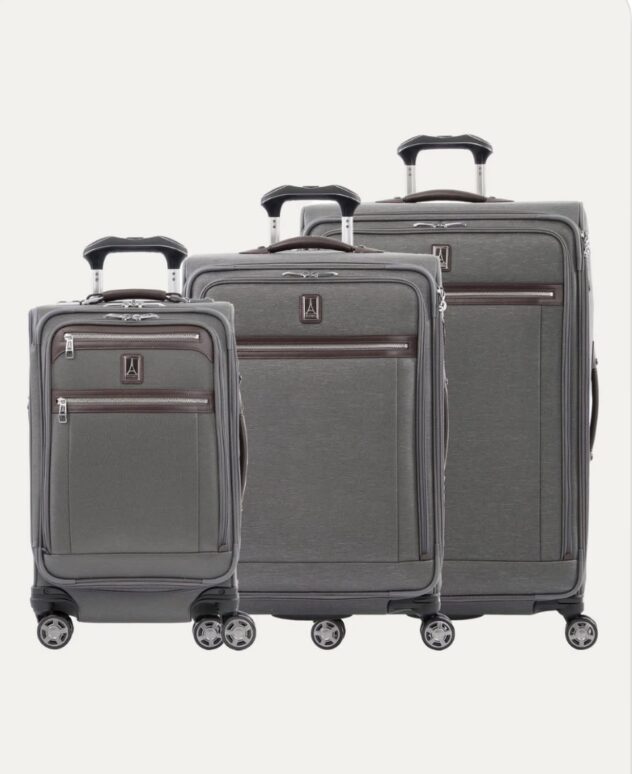
The right luggage can make or break a trip. For years I have been trudging through airport parking lots and terminals lugging outdated bags that weighed heavily on my back, shoulders and arms. Carry-on bags with wheels that don’t look like they should be as heavy as they end up being, suitcases with wheels that get caught, zippers that get stuck or have pulls that break easily, surfaces that tear or stain, absorb water, and straps that break. After seeing my struggle through several trips last year, my partner offered to buy me a new suitcase. And after having done some extensive research on luggage brands, I bought a Travelpro carryon. I could not be happier with my choice. This is the only suitcase I travel with now, in addition to their under-seat tote. Thinking of purchasing their check-in suitcase next. Here’s why:
There’s a telling detail about Travelpro luggage that no marketing campaign could manufacture: walk through any major airport and notice what the pilots and flight attendants are rolling behind them. More often than not, it’s a Travelpro. These are people who travel for a living, who board more planes in a month than most of us do in a year, and who have zero tolerance for luggage that fails them. Their choice says everything.
Founded in 1987 by a Northwest Airlines pilot named Bob Plath, Travelpro was quite literally built by someone who needed luggage to perform under real-world conditions. The original Rollaboard — the wheeled carry-on bag that is now ubiquitous in airports worldwide — was actually Travelpro’s invention. Before Plath engineered a bag with an integrated telescoping handle and inline skate wheels, flight crews were lugging heavy bags through terminals by hand. That DNA — functional, durable, engineered for the road — is still woven into every bag the brand makes.
What Makes Travelpro Different?
The Wheels Are in a Category of Their Own
Ask anyone who owns a Travelpro what they love most, and the answer is almost always the wheels. The flagship Platinum Elite line features what the brand calls its MagnaTrac spinner system — four dual wheels with embedded magnets that self-align as you change direction. In practice, this means the bag tracks smoothly beside your hip without veering, vibrating, or tipping. One reviewer from Outdoor Gear Lab, who tested multiple versions of the bag over several years, described it as gliding better than any other product in their entire luggage lineup. When they let go of the handle during testing, the bag continued to track straight ahead on its own.

This matters enormously on a long travel day. The difference between wrestling a wobbly suitcase through a crowded terminal and simply guiding a well-engineered one is the difference between arriving exhausted and arriving composed.
Built to Take a Beating
Travelpro’s flagship softside bags are constructed from ballistic nylon — the same tightly woven fabric originally developed for military body armor. Reinforced corners, metal-trimmed wheel housings, and chrome zipper pulls aren’t decorative choices; they’re engineering decisions made with airport floors, overhead bins, and baggage handlers in mind.
In durability testing, one reviewer pushed a Platinum Elite down a flight of stairs and dropped it on its head. The bag emerged with only a few scuffs on its reinforced corners. This is the kind of abuse checked luggage regularly endures, and most bags don’t survive it as gracefully.
The softside construction also has an advantage over hard-shell alternatives: it doesn’t dent. While polycarbonate and ABS shells can crack or crease permanently from an impact, the Travelpro’s nylon exterior absorbs and recovers. Everyday scuffs and scratches essentially disappear into the fabric.
Smart, Thoughtful Organization
Travelpro’s layouts are designed by people who actually pack for trips, not by people who photograph empty bags for catalog shoots. The Platinum Elite carry-on, for instance, includes a removable garment bag for dress clothes, a built-in toiletry pouch, a USB port for device charging, a tag holder, and multiple internal pockets with logical placement. There’s also a side grab handle and a bottom handle — the latter being something many competing bags overlook entirely, but which proves invaluable when pulling a bag out of an overhead bin or lifting it onto a scale.

One tester noted that she had to use the bottom handle more often than she anticipated, and that it was a feature many suitcases simply don’t have.
Water Resistance That Actually Works
During hose testing designed to simulate a two-minute downpour, the Platinum Elite’s interior remained essentially dry, with water rolling off the nylon exterior and the zippers keeping most moisture out. Only the outermost exterior pockets showed noticeable water ingress — a good reason to keep valuables in interior compartments during rain.
For travelers navigating European cobblestones in a sudden shower or dashing between terminals in a downpour, this matters.
How Travelpro Compares to the Competition
Travelpro vs. Away

Away has built a devoted following on the strength of its minimalist aesthetic and direct-to-consumer model. Its hard-shell polycarbonate cases look sharp and photograph beautifully. But Away’s clean exterior comes at the cost of exterior pockets — there are none — and the hard shell, while protective, can crack or dent permanently under impact. Away is an excellent choice for the occasional traveler who values style and simplicity. For frequent travelers who want exterior organization and a bag that rolls with precision after hundreds of flights, Travelpro is the more functional choice.
Travelpro vs. Samsonite

Samsonite is the world’s largest luggage brand, and it makes solid bags across a wide range of price points. Its Freeform and Omni lines offer competitive durability and capacity. Where Travelpro edges ahead is in the detail work: the self-aligning wheel system, the quality of the telescoping handle, and the organizational features that come standard on the Platinum Elite rather than as an upgrade. Samsonite bags are very good; Travelpro bags at the same price feel engineered to a slightly higher standard.
Travelpro vs. Briggs & Riley

Briggs & Riley is arguably Travelpro’s closest competitor in the premium softside market — and it’s genuinely excellent luggage with a legendary lifetime guarantee that covers even airline damage. But Briggs & Riley carries a significantly higher price tag. Travelpro’s Platinum Elite offers comparable real-world performance at a lower cost. For the traveler who wants exceptional quality without paying for the most premium tier, Travelpro represents arguably the best value in the category.
Travelpro vs. Tumi

Tumi occupies the luxury end of the luggage market, and its bags are beautifully made. But you’re paying considerably more for materials and branding. Tumi makes sense for executives who want a status signal alongside their luggage. Travelpro makes sense for everyone who wants the bag to simply perform — and perform for years.
The Travelpro Line: Which Bag Is Right for You?

Platinum Elite is the flagship collection — the one airline crews reach for. It features MagnaTrac wheels, premium ballistic nylon, leather handles, and the most comprehensive organizational features. This is the bag to buy if you travel frequently and want luggage that lasts a decade.

Crew VersaPack is designed with modular accessories that attach to the bag itself, keeping small items organized and accessible without digging through compartments. An excellent choice for business travelers managing cables, chargers, and documents.

Maxlite is the lightweight option for travelers who want to maximize carry-on packing without fighting weight limits. It sacrifices some durability features for a lighter build, but remains solidly constructed.

Pathways is the entry into Travelpro’s hardside lineup — a sleek, impact-resistant option with a TSA-approved lock and a clean, modern profile.
The Bottom Line
Good luggage doesn’t make travel glamorous. It makes travel easier. And that’s precisely Travelpro’s promise — not the flashiest bag on the carousel, but the one that rolls better, lasts longer, and works harder than anything in its price range.
Independent reviewers who tested it alongside more than a dozen competing carry-ons named it the top recommendation based on how effectively it balances quality, features, and performance with price. It has held that position not because of a splashy rebrand or a viral moment, but because the bag keeps delivering — year after year, trip after trip.
When the pilots choose it for their own travels, that’s not a marketing story. It’s a product review.
This post contains affiliate links. If you click through and make a purchase I may receive a small commission at no extra cost to you.