
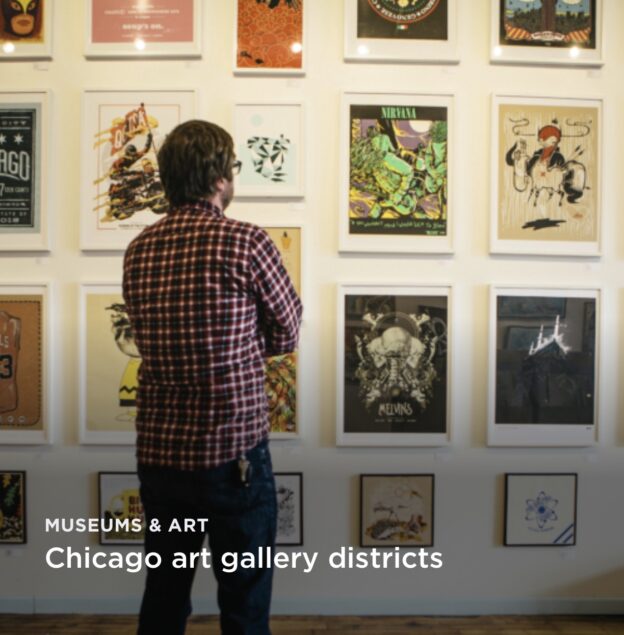
A neighborhood-by-neighborhood guide to where the city’s gallery scene actually lives
For someone accustomed to New York’s famously concentrated gallery districts, Chicago takes a little more effort — and rewards it.
Between the museums, the public sculpture, and Richard Gray’s gallery just off Michigan Avenue, this trip kept circling back to one realization: Chicago’s art world doesn’t live in a single neighborhood the way it once did. It’s scattered across several distinct districts, each with its own character, history, and reasons to visit. For anyone planning a more gallery-focused day in the city, here is where to actually go.
River North — The Original Gallery District

River North is where Chicago’s modern gallery scene began. Starting in the 1970s, the neighborhood’s cheap former warehouse space attracted photographers, ad agencies, and galleries in large numbers, and at its peak, River North held the largest concentration of art galleries in the United States outside of Manhattan. Decades of rising property values have thinned the ranks considerably since, with many of the original storefronts giving way to high-rises, but a real core remains, now centered a few blocks west around North Clark Street. The blocks immediately surrounding the Merchandise Mart double as the city’s actual interior design district, lined with to-the-trade showrooms for furniture and home furnishings — worth knowing if design, not just fine art, is part of your interest.
West Loop — The Newer Heavyweight

If River North was the gallery district of the 1980s and 90s, the West Loop is its current-day successor. Better known to most visitors for its restaurant row, the neighborhood quietly built a serious contemporary gallery scene inside former meatpacking plants and industrial buildings, particularly along West Carroll, Fulton Street, and West Chicago Avenue beyond Addison. Several major names have planted roots here, drawn by the same combination of large, raw spaces and an increasingly serious collector base that has made the neighborhood Chicago’s most-watched art destination of the past decade.
West Town — Where the Established Names Relocated

A number of River North‘s most historically significant galleries, priced out of their original neighborhood, have since resettled in West Town, giving the area an outsized concentration of serious, decades-old programs relative to its size. It’s a quieter gallery-going experience than the West Loop’s buzzier scene — closer to a considered studio visit than a destination outing.
Pilsen — The Cutting Edge

The Chicago Arts District, centered at 18th and Halsted in East Pilsen, is the city’s most artist-driven gallery neighborhood, built largely on the legacy of developer John Podmajersky III, who began buying property in the area back in 1987. More than thirty galleries and artist studios throw open their doors together on the second Friday of every month, with wine, conversation, and exhibitions spanning painting, fashion, and theater — a genuinely communal, lower-key counterpart to the more commercial districts elsewhere in the city. Of Chicago’s gallery neighborhoods, this is generally considered the most experimental and emerging.
Wicker Park / Bucktown

A smaller but increasingly notable scene has grown up here as well, anchored by the Flat Iron Arts Building, where resident artists open their studios to the public on First Fridays. It’s worth a stop for anyone interested in catching emerging talent before it moves on to a bigger gallery elsewhere in the city.

A Short List of Galleries Worth Knowing
If your time is limited, these are the names that come up again and again as the city’s most consequential:

Richard Gray Gallery (Hancock Tower & West Town) — founded 1963, one of the oldest and most internationally significant programs based in Chicago; the subject of its own post in this guide.

Corbett vs. Dempsey (West Town) — founded 2004, with a strong focus on Chicago and Midwestern art history alongside international contemporary work.

Kavi Gupta (West Loop, two locations) — large-scale program representing international emerging and mid-career artists across multiple genres.

Mariane Ibrahim (West Loop) — with sister locations in Paris and Mexico City, focused on artists from Africa and the African diaspora.

Carrie Secrist Gallery (West Loop) — founded 1992, representing established and mid-career contemporary artists across a wide range of media.

Zolla/Lieberman (River North) — founded 1976 in a converted loft space, one of the original anchors of the River North gallery district.
Lisa’s Take
What I find most interesting about Chicago’s gallery scene is that it feels less centralized than New York’s — and perhaps more connected to the neighborhoods in which it developed. River North tells the story of Chicago’s emergence as a serious contemporary art center; West Town and the West Loop reflect where that energy has moved; and Pilsen offers a much more grassroots version of the same impulse.
Having worked in the art world for much of my career, I’ve learned that a city’s galleries tell you something its museums can’t. Museums preserve and interpret what has already entered the conversation. Galleries reveal what people are arguing about, collecting, experimenting with and championing right now.
That’s what makes exploring Chicago’s gallery districts so rewarding. You’re not simply looking at art. You’re getting a glimpse of the art world in motion.
Why It Belongs on the List
Chicago’s gallery scene rewards exactly the kind of slow, neighborhood-by-neighborhood exploration that a museum visit simply can’t offer. Between River North’s history, the West Loop’s current energy, and Pilsen’s grassroots spirit, there’s a genuinely different version of the city’s art world waiting in each one — and unlike the museums, every single stop is free to walk into.
For the rest of where we stayed, ate, researched and explored on this trip, look for the complete Chicago guide coming soon to The Insider’s Guide. In the meantime, stay tuned for the next blog post in this Chicago series.
Featured photo credit: choosechicago.com


