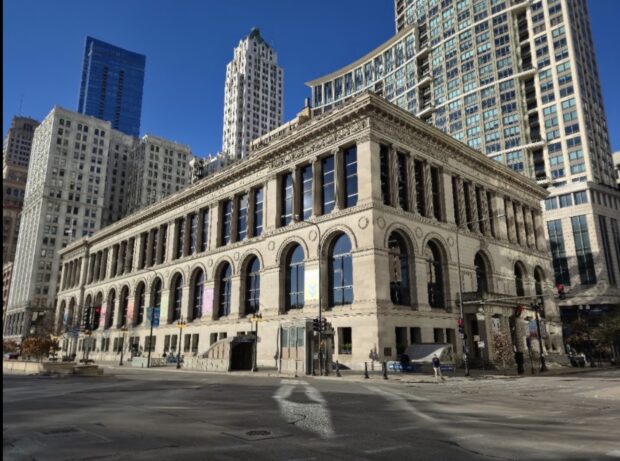
A former public library, two monumental stained-glass domes, and the best free afternoon in the city
Having just spent an afternoon admiring the Tiffany dome tucked above the cosmetics counters at Macy’s on State Street, we were perfectly content believing we had already seen Chicago’s greatest Tiffany masterpiece. We hadn’t. The Chicago Cultural Center, a few blocks away on Michigan Avenue, proved us wonderfully wrong. It holds the actual title holder — the largest Tiffany stained-glass dome in the world — and it does so inside a building you can walk into entirely free of charge. After years spent cataloguing decorative arts for the auction world, I don’t say that lightly: this building stopped us in our tracks twice in the same afternoon.
Built to Prove a Point
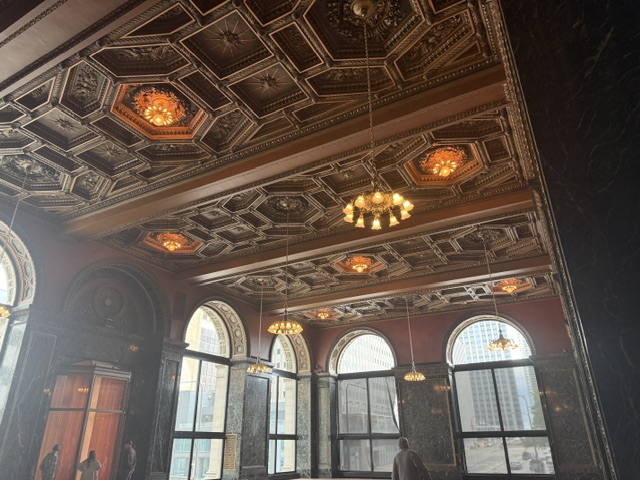
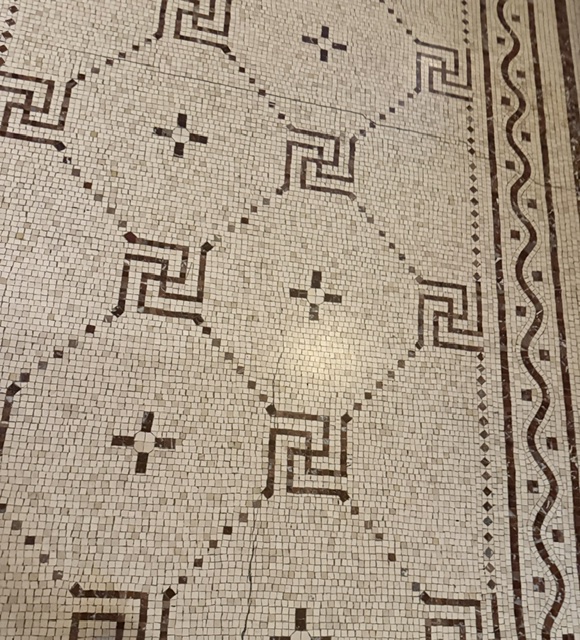
The building opened in 1897 as Chicago’s first central public library, designed by the Boston firm of Shepley, Rutan and Coolidge — the same architects behind the original Art Institute of Chicago building — and conceived quite deliberately as a statement. Barely a generation removed from the Great Fire, the city wanted an architectural showplace that proved Chicago had become a genuinely sophisticated metropolis. The team behind it didn’t hold back: interiors modeled on the Doge’s Palace in Venice, the Palazzo Vecchio in Florence, and the Acropolis in Athens, finished with rare imported marbles, polished brass, fine hardwoods, and mosaics of Favrile glass, mother-of-pearl, and colored stone throughout. The building stands 104 feet tall, with three-foot-thick masonry walls faced with Bedford Blue Limestone on a granite base, and it is capped symmetrically by two monumental stained-glass domes — one on each wing.
The library eventually outgrew the space and relocated to the Harold Washington Library Center, and by the mid-1960s the building itself seemed headed for demolition, considered obsolete the way many structures of its era were at the time. A dedicated group of preservationists fought to save it, and the effort earned a notable boost when Eleanor “Sis” Daley, the famously reticent wife of Mayor Richard J. Daley, spoke up personally in its favor. The building was added to the National Register of Historic Places in 1972 and designated a Chicago Landmark in 1976. In 1991, it was formally established as the Chicago Cultural Center — the country’s first free, comprehensive municipal cultural venue of its kind.
The Preston Bradley Hall Tiffany Dome
The building’s southern wing holds its most celebrated feature: the Tiffany dome above Preston Bradley Hall, named after the beloved Chicago civic leader and clergyman who championed the building’s preservation for decades. The room itself was originally where library patrons came to collect the books they had requested — a quietly poetic origin for a space that now draws visitors from around the world simply to stand inside it and look up.
The dome is 38 feet in diameter, made of Tiffany Favrile glass cut in the shape of fish scales, growing lighter in color from base to crown. At its very top sits a glass rosette encircled by the twelve signs of the zodiac, and around the base runs an inscribed quotation from the British essayist Joseph Addison. The dome glass, lighting fixtures, wall sconces, and chandeliers were all made by the Tiffany Glass and Decorating Company of New York, with the supporting frame constructed by the Chicago Ornamental Iron Company. Tiffany’s hand extends well beyond the dome itself: by sequencing Favrile glass, mother-of-pearl, and semi-precious stones at slight angles across more than 10,000 square feet of surrounding mosaic, the entire room was designed to shimmer as it reflects and refracts ambient light. It does exactly that, and it does it differently at every hour of the day.


What makes the dome’s story even richer is what happened to it in the decades between its creation and its current glory. For much of the twentieth century, the dome was covered with a false ceiling and simply hidden from view — a concrete and copper exterior shell, added over the glass, blocked the natural light Tiffany had originally designed around. The 2008 restoration corrected all of that: the covering was removed entirely and replaced with a translucent, energy-efficient alternative, returning natural light to the hall for the first time in generations. The cast iron framework was restored to its original aluminum leaf finish, delicate rosette lighting around the cornice was refurbished, and every individual glass panel was taken apart, hand-cleaned, repaired where necessary, and releaded before being reinstalled. Standing beneath it now, in the late afternoon when the light is at its most generous, is genuinely one of the most beautiful experiences Chicago has to offer. The dome has been formally valued at over $35 million. It is the largest Tiffany stained-glass dome in the world.
The Grand Army of the Republic Dome
The northern wing holds the building’s second dome, and the one that most visitors — understandably distracted by the Tiffany’s fame — walk straight past. They are missing something genuinely remarkable. The Healy and Millet dome above the Grand Army of the Republic Memorial Hall spans 40 feet across and contains approximately 50,000 pieces of glass arranged in a complex Renaissance pattern — more glass in total than the Tiffany dome itself. The hall’s rotunda features 30-foot walls of Knoxville pink marble and a mosaic floor, with the symbols of sixteenth-century master painters displayed in the supporting arches and the names of great authors and inscriptions in ten ancient and modern languages extolling the love of learning running throughout. The hall was dedicated to the Civil War veterans of the Grand Army of the Republic, and that context gives the room a gravity that the more overtly decorative Tiffany dome doesn’t carry in quite the same way.


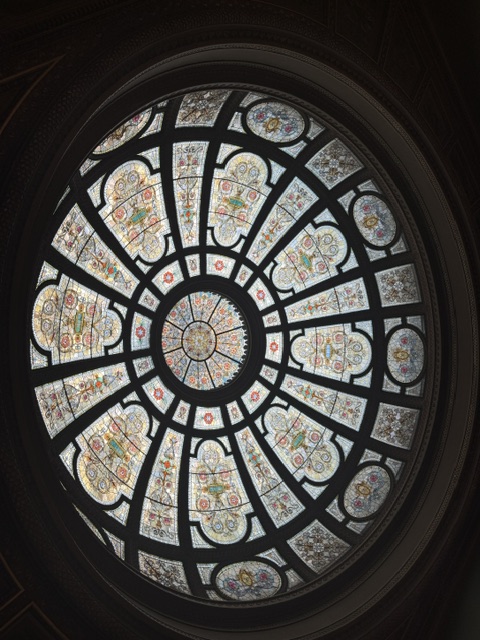
Where the Tiffany dome is all shimmer and light — iridescent, optimistic, almost celestial — the Healy and Millet dome has aged into something darker and more contemplative, its glass deepened by time into richer, moodier tones. Standing beneath the two of them in sequence, just steps apart inside the same building, is one of the more instructive experiences in decorative art I’ve had anywhere: two completely different approaches to the same medium, the same era, and the same ambition, producing results that couldn’t be more distinct from each other.
Beyond the Domes
The building itself is only part of the draw. The Chicago Cultural Center hosts free music, dance, theater, film, and lecture programming year-round, alongside rotating visual art exhibitions, drawing hundreds of thousands of visitors annually and ranking among the city’s most-visited attractions. The Sidney R. Yates Gallery, a faithful recreation of an assembly hall in the Doge’s Palace in Venice, is worth a look on its own merits. Guided architectural tours are available, including one led by cultural historian Tim Samuelson, for anyone who wants the full story behind every inch of the building rather than simply wandering the halls. A late-afternoon visit, when sunlight floods through the Tiffany dome at its most generous angle, is the timing I’d recommend above all others.

Why It Belongs on the List

Between this stop and the Tiffany dome at Macy’s on State Street, our Chicago trip quietly became a small, entirely unplanned tour of the city’s greatest decorative glass. The Cultural Center is the rare attraction that costs nothing and still manages to be one of the most genuinely beautiful interior spaces in America. Two world-class domes, a building steeped in the city’s cultural history, free programming every week of the year, and a door that’s open to anyone who walks through it. If you only have room for one more stop on a downtown itinerary, make it this one. And when you get there: look up. Always look up.+
Lisa’s Take
Would I Recommend It? ★★★★★ Without hesitation.
Best For: Lovers of architecture, decorative arts, history, photography, and anyone who believes some of the finest travel experiences don’t require an admission ticket.
Allow: 60–90 minutes (longer if you’re taking a tour or visiting an exhibition).
Don’t Miss: Both domes. Most visitors stop beneath the Tiffany masterpiece and leave. Walk across the building to experience the Grand Army of the Republic Dome as well—the contrast between the two is part of what makes this building so extraordinary.
Worth the Time?
Absolutely.
One of the joys of travel is discovering that the concierge sometimes gives you a better itinerary than the guidebook. This, along with the Tiffany Dome in Macy’s, were suggestions from our concierge, Gary at The Peninsula Hotel. We couldn’t be more grateful!
Chicago has world-class museums that deserve every accolade they receive, but the Cultural Center offers something wonderfully unexpected: one of the city’s greatest artistic treasures, entirely free to anyone who walks through its doors. If you appreciate beautiful craftsmanship, thoughtful architecture, and the kind of places that reward slowing down, don’t miss it.
For the rest of where we stayed, ate, and explored on this trip, look for the complete Chicago guide coming soon to The Insider’s Guide. In the meantime, stay tuned for the next post in this Chicago series.