
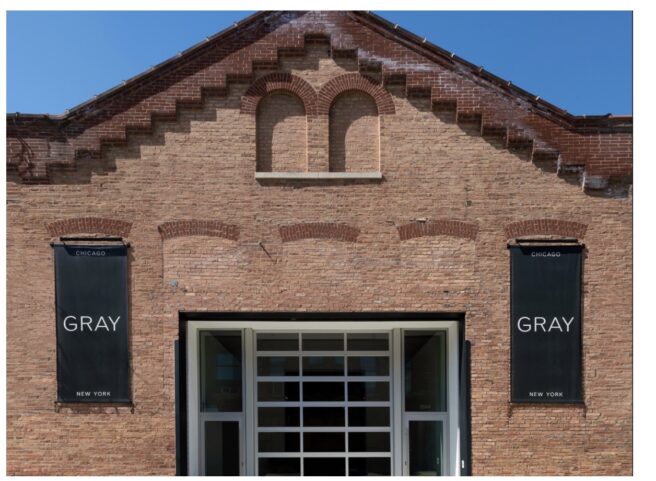
The architect-turned-dealer who helped put Chicago’s art scene on the international map
I have a particular fondness for dealers whose personal story is every bit as interesting as the artists on their walls. Richard Gray is exactly that kind of figure — a Chicago institution whose gallery, founded in 1963, helped shape the city’s entire relationship with international art, and whose fingerprints turn out to be on more of this Chicago trip than I initially realized.
An Architect Who Fell Into Art Dealing
Gray’s path to the gallery world was almost accidental. Born and raised in Chicago, he initially enrolled in engineering at the University of Illinois, expecting to eventually join his father’s construction business, before transferring to the Urbana-Champaign campus to study architecture instead. After serving in the Air Force in Europe, he returned home and, in 1953, married Mary Kay Lackritz, whose family collected paintings by Miró, Kandinsky, and Pollock. That marriage planted the seed; a friendship with sculptor and critic Harry Bouras, who had organized a show at his father’s company, gave Gray the actual idea to open a gallery of his own.
He opened Richard Gray Gallery on November 4, 1963, at 155 East Ontario Street, in a modest rented space with a young family at home and no formal art world pedigree behind him — just genuine passion and a trained architect’s eye. It would prove to be one of the more consequential decisions in Chicago’s cultural history.
A Roster That Reads Like an Art History Survey
From the outset, Gray’s program was genuinely ambitious. The gallery became one of the first spaces in the city to show work by Jules Olitski, Morris Louis, Hans Hofmann, Louise Nevelson, and Jim Dine, alongside modernists like Fernand Léger, Pablo Picasso, Josef Albers, and Milton Avery. Over the decades, the artist list only grew more remarkable: Andy Warhol, Philip Guston, Roy Lichtenstein, Agnes Martin, Mark Rothko, and Richard Diebenkorn all showed at Gray’s gallery at one point or another, alongside Gray’s own enthusiastic, somewhat unfashionable interest in Aboriginal and African art, antiquities, and prints and drawings.
By 2012, the gallery’s annual sales were reported at just under $100 million, with clients spanning more than ten percent of the Forbes 400, plus museum curators and major collectors from Europe, Asia, the Middle East, and South America. Today, under the leadership of Gray’s son Paul and partner Valerie Carberry, the gallery continues representing artists including Jaume Plensa, David Hockney, Alex Katz, Theaster Gates, and Rashid Johnson, with locations in Chicago and on Madison Avenue in New York.
The Gallery Behind the Crown Fountain

Here’s a connection I didn’t expect to find: Richard Gray was an early supporter of Spanish artist Jaume Plensa and helped bring Plensa’s work into Chicago’s larger cultural conversation. Plensa would ultimately create Crown Fountain for Millennium Park — the very installation we had stood beside earlier in the trip, watching children run through the water beneath enormous faces of their fellow citizens.
Suddenly, the fountain we had experienced as visitors became part of a much larger story: Chicago’s art world isn’t a collection of isolated institutions. The galleries, artists, collectors, museums and public spaces continually intersect.
A Legacy Beyond the Gallery Walls
Gray’s influence extended well past his own program. He helped found the Chicago Art Dealers Association in 1967 and served as one of its early presidents, and in 1998 became the first dealer based outside New York to be elected president of the Art Dealers Association of America. He served as a trustee of the Art Institute of Chicago, which named its Richard and Mary L. Gray Wing for prints and drawings in his honor in 2008, drawing on the couple’s own collection of works by Rubens, Delacroix, and Matisse. The University of Chicago’s Smart Museum and its Richard and Mary L. Gray Center for Arts and Inquiry, established in 2013, carry the family name as well, alongside a deep, decades-long commitment to historic preservation that included helping save Mies van der Rohe’s Farnsworth House.
Richard Gray passed away in 2018 at 89, but by every account his influence on Chicago’s cultural landscape is still very much active. As one tribute at the time put it, his gallery’s exhibitions brought genuine greatness to the city, and his philanthropy extended well beyond the visual arts into the broader cultural life Chicago still enjoys today.

Lisa’s Take
What I find most fascinating about Richard Gray’s story isn’t the list of famous artists who passed through his gallery, impressive as that list is. It’s the idea that a dealer working in Chicago could look outward, recognize international talent, and help create the conditions for that work to matter here.
After years in the art world myself, I’ve come to appreciate that galleries are more than places where art is bought and sold. The best dealers become connectors — between artists and collectors, museums and communities, established ideas and new ones.
Richard Gray seems to have understood that instinctively. And walking through Chicago on this trip, I began to see how many of the city’s cultural experiences are connected by precisely those kinds of relationships.
For the rest of where we stayed, ate, researched and explored on this trip, look for the complete Chicago guide coming soon to The Insider’s Guide. In the meantime, stay tuned for the next blog post in this Chicago series.


