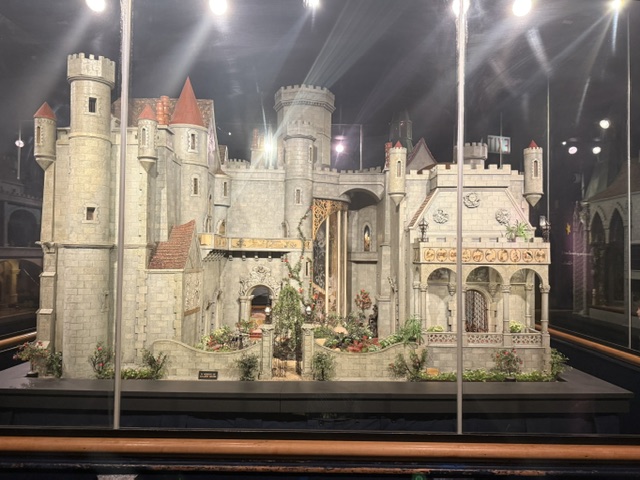
A childhood memory from 1965, and the strange comfort of finding it exactly as I’d left it

Some exhibits you visit out of curiosity. This one I visited out of memory. I have a distinct recollection of standing in front of Colleen Moore’s Fairy Castle on a family trip to Chicago in the summer of 1965, and the image of it never fully left me in the sixty years since. Returning to it as an adult was its own small act of time travel — and, to my genuine surprise, it moved me almost exactly the way it did as a child.
A Silent Film Star’s Lifelong Obsession

The castle’s story begins long before it ever reached Chicago. Colleen Moore was one of Hollywood’s biggest stars of the 1920s, a flapper icon known for her bobbed hair and her starring role in defining that era’s image on screen. Her fascination with miniatures, though, was a private passion that had nothing to do with fame. Beginning around 1928, she enlisted a team of Hollywood’s finest artists, designers, and craftspeople to help her build an elaborate dollhouse unlike anything that had existed before — one built not as a child’s toy, but as a genuine work of art.


The finished castle, completed in 1935, stands with its tallest tower reaching seven feet, seven inches, built at a scale of one inch to one foot. It’s constructed from a startling list of real materials — gold, silver, ivory, jade, crystal, alabaster, mother-of-pearl — and filled with treasures that are anything but make-believe: a Syrian vase dating to around A.D. 740, stained glass salvaged from Lambeth Palace after it was blown out during a World War II bombing raid, a Mickey and Minnie Mouse painting by Walt Disney himself, and an autograph book Moore collected from friends including Albert Einstein and Eleanor Roosevelt.


From Depression-Era Fundraiser to Permanent Home
What I didn’t know as a child gazing at the castle was the generosity behind it. In 1935, as the Great Depression deepened, Moore sent the castle on a national tour, displaying it in the toy departments of major stores like Macy’s and Chicago’s own The Fair, raising more than $650,000 for children’s charities between 1935 and 1939. It was, by every account, an enormous success — people returned to see it again and again, exactly the way I apparently did, decades later, in my own memory.
The castle found its permanent home in 1949, after Major Lenox Lohr, then director of the museum, struck up a conversation with Moore over dinner and, as she later described it, had secured her doll house by dessert. It’s been on display ever since, kept behind protective glass with carefully controlled light, temperature, and humidity to preserve it for future generations — mine included, evidently.
Eleven Rooms of Genuine Wonder
Standing in front of it again, what struck me was how little the experience had actually changed. The Great Hall, the castle’s largest room, still has its etched ivory floor and a ceiling painted with figures from Brothers Grimm fairy tales. The floating staircase still has no railings, because, as the museum’s own lore has it, fairy folk balance themselves with their wings. The Chapel still holds its tiny stained-glass windows and a Russian icon set with diamonds and emeralds, taken from a brooch Moore donated herself. Eleven rooms in total, each one a small, fully realized world.
One detail I particularly love: as you circle the castle, the narration describing each room’s treasures is Colleen Moore’s own recorded voice, explaining in her own words why the floating staircase has no railing, or what the sea-motif furniture in the library was designed for. There’s something wonderful about hearing the woman who imagined all of it tell you, decades later, exactly what she meant by each detail.
I’m told the castle underwent a significant conservation project in 2013 and 2014, replacing its original eighty-year-old electrical and plumbing systems, which had begun causing real damage to the structure. As part of that work, the willow tree in the castle’s courtyard, which had originally wept real water, lost its water feature for good — the moisture was found to be harmful to the surrounding artifacts and difficult to control inside the climate-sensitive case. The tree now has a sequence of running lights in its place. It’s a small, sensible compromise, and everything else about the castle, as far as I could tell, looked exactly as it had in 1965.
A Marvel of Engineering, Not Just Imagination
It’s worth pausing on why this dollhouse lives inside a science museum at all, rather than an art museum or a historical society. The Fairy Castle was technologically advanced for its era in ways that go well beyond its artistry: the castle is fully electrified, with working lights illuminating its tiny rooms, and it was originally built with a functioning system of plumbing, with real water running through its miniature pipes and weeping down the courtyard willow tree. For something built in the early 1930s, at one-twelfth scale, that’s a genuine feat of engineering — not just a beautifully decorated box, but a small working piece of architecture. That combination of art and applied science is exactly the kind of marvel this museum was built to celebrate.
Two Ways of Seeing the Same Castle
What truly gobsmacked me, standing in front of it again after sixty years, was realizing I was seeing it through two lenses at once. As a child, the castle simply was every storybook and fairytale I’d ever imagined, made suddenly, impossibly real — the Brothers Grimm ceiling, the floating staircase, the chapel’s tiny stained glass, all of it exactly as wondrous as a child’s imagination demands. That feeling came rushing back instantly and fully intact.
But as an adult, a second layer of appreciation arrived right alongside it: an understanding of the sheer thought, engineering, and detail that went into making that fantasy physically real. Knowing now what it took to wire those tiny lights, to run water through pipes smaller than a finger, to source a centuries-old Syrian vase and stained glass salvaged from a bombed London palace and fit it all into a story-driven whole — that recognition didn’t replace the childhood wonder. It sat directly on top of it. Both reactions were true at the same time, and both were just as strong. Even my partner, who’d never seen the castle before, came away genuinely impressed — proof that this isn’t simply nostalgia talking.
Wonder Shared
Since returning home, I’ve gone down something of a rabbit hole reading about other people’s experiences with the castle, and what I found was reassuring in its own way: the same reaction, described over and over, by visitors decades apart. Reviews and personal essays from people who first saw it as children, often years before me or long after, describe almost identical feelings — the same sense of wonder on first sight, and the same layered appreciation on return visits as adults. The fact that the Fairy Castle has remained a permanent exhibit since 1949, virtually unchanged in spirit even as conservation work has updated what’s behind the scenes, speaks to exactly that kind of staying power. This isn’t a nostalgic reaction unique to me. It’s evidently the entire point of the thing.
Why This One Stayed With Me
I’ve thought a great deal about why this particular exhibit, of everything I’ve seen over a lifetime of travel, has held on so tightly in memory. I think it’s this: the Fairy Castle isn’t really about scale or material value, impressive as both are. It’s about the sheer, sustained attention of one person’s imagination, carried out in painstaking detail simply because she believed it was worth doing beautifully and doing it right, down to the working plumbing. As a child, I felt that without being able to name it. As an adult, standing in front of it again, I understood exactly what I’d been responding to all along — and felt the same quiet wonder all over again, now doubled by genuine admiration for the execution of Colleen Moore’s dream.
Some places impress us. A very few become part of who we are. For me, Colleen Moore’s Fairy Castle has quietly occupied that place for more than sixty years and will likely continue to through my remaining years.
For the rest of where we stayed, ate, and explored on this trip, look for the complete Insider’s Guide to Chicago – coming soon. In the meantime, stay tuned for the next post in this Chicago series.