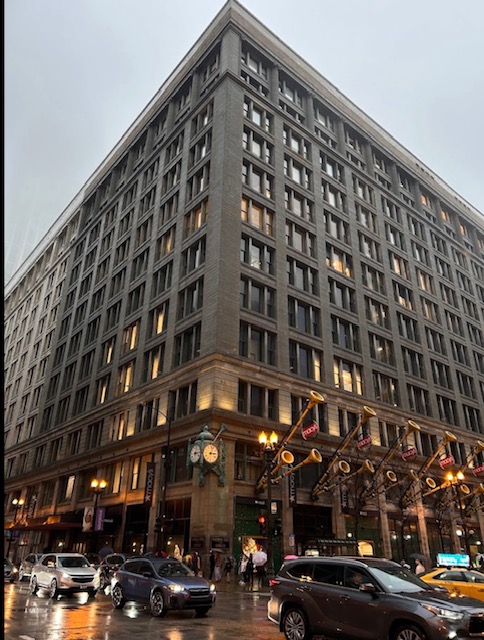
A Gilded Age masterpiece hiding in plain sight above the cosmetics counter, in a building that will always be Marshall Field’s at heart
Given my background cataloguing decorative arts for the auction world, I have a soft spot for masterworks hiding where shoppers least expect them. There may be no better example in the country than the Tiffany dome inside Macy’s on State Street, Chicago — a building that, no matter what the signage says, will always be Marshall Field’s to Chicago. You simply have to remember to look up.


The Largest Tiffany Mosaic in Existence


Completed in 1907 and set above what is now the cosmetics department, the dome is the work of Louis Comfort Tiffany, working under his own direct supervision with a team of roughly fifty artisans over the course of eighteen months. The finished mosaic spans more than 6,000 square feet and contains somewhere upward of 1.6 million individual pieces of iridescent glass, packed in at a density of about two pieces per square inch. It remains, by a wide margin, the largest glass mosaic Tiffany ever produced.
The glass itself is an example of Tiffany’s celebrated favrile technique, a firing process that allowed him to create an essentially unlimited range of color and texture within the glass itself, rather than painting or staining the surface afterward. Stand beneath it as the light shifts throughout the day, and the dome genuinely seems to change color — which is, of course, exactly the effect Tiffany was after.
Where and How to See It
Most visitors stumble onto the dome quite by accident, glancing up while shopping the ground floor cosmetics counters. The better view, by far, is from above: head to the fifth floor women’s lingerie department, where the dome’s full vaulted scale and detail finally come into focus rather than being foreshortened from below.
Four Tiffany glass globes once hung suspended from the ceiling as well; two have since been repaired and rehung, one remains broken and in storage, and the fourth, oddly enough, now lives at Target’s corporate headquarters — a small, strange footnote to an otherwise grand story.


The Store Marshall Field Built
The dome only makes sense in the context of the man who commissioned the building around it. Marshall Field worked his way up through Chicago’s retail trade before buying out his partners entirely in 1881 and rebranding the business as Marshall Field & Company. Under his leadership, the store became a genuine pioneer of modern retail: it introduced an in-house restaurant decades before that was standard practice, encouraged browsing without obligation to buy, and built its entire reputation around the now-famous motto, “Give the lady what she wants.” At a moment when women’s independent presence in public life was still being negotiated, Field deliberately positioned his store as a respectable destination where women could shop and socialize without an escort — a quietly progressive stance for its era.
The flagship building itself, designed primarily by Daniel Burnham in the Beaux-Arts style, went up in stages between 1892 and 1907, with later additions following in 1914. At its peak it held the title of the largest store in the world, a sprawling 73 acres of selling floor under one roof, and it remains a designated National Historic Landmark today. The exterior’s great corner clocks became such a fixture of daily Chicago life that “meet me under the clock” was, for generations, simply understood.

A Legacy Macy’s Has Chosen to Honor
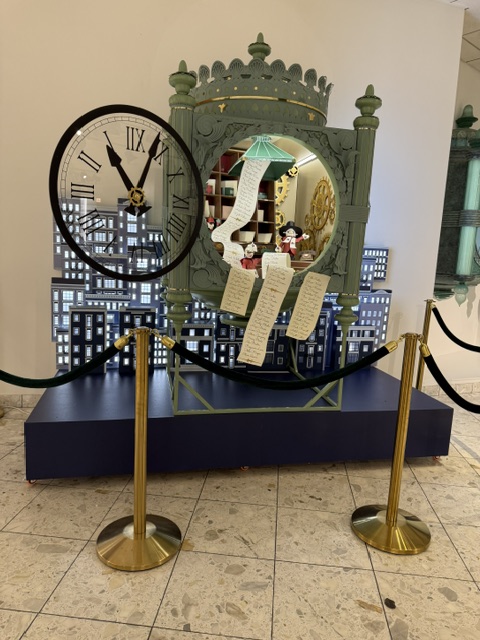
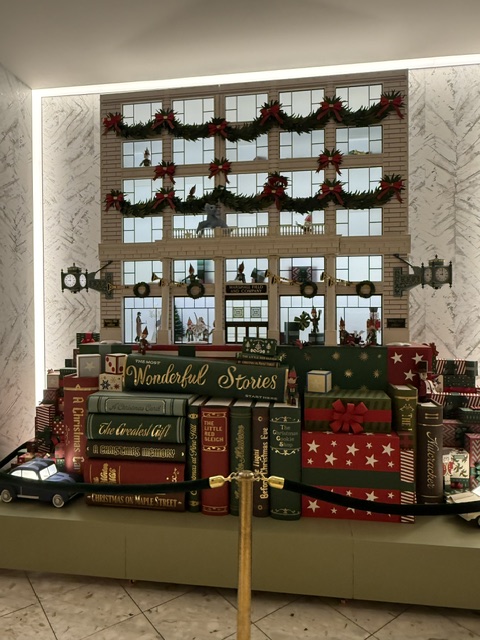
Macy’s acquired Marshall Field & Company in 2005 and rebranded the State Street store the following year, a change that, even now, two decades on, still draws a measure of good-natured Chicago outrage. To its credit, Macy’s has increasingly leaned into honoring rather than erasing that history. The store’s celebrated seventh-floor restaurant, opened in 1907 as the very first restaurant inside an American department store, has been formally renamed The Marshall Field’s Walnut Room, complete with a commemorative plaque at its entrance. Recent holiday seasons have gone further still, with the restaurant’s famous forty-five-foot Great Tree, the building’s animated storefront windows, and seasonal displays throughout the store all built around explicit Marshall Field’s themes — right down to reproductions of the iconic green clock scattered through the dining room.

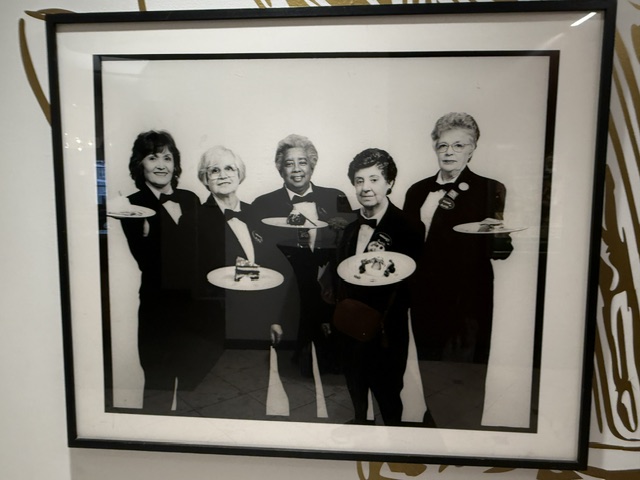

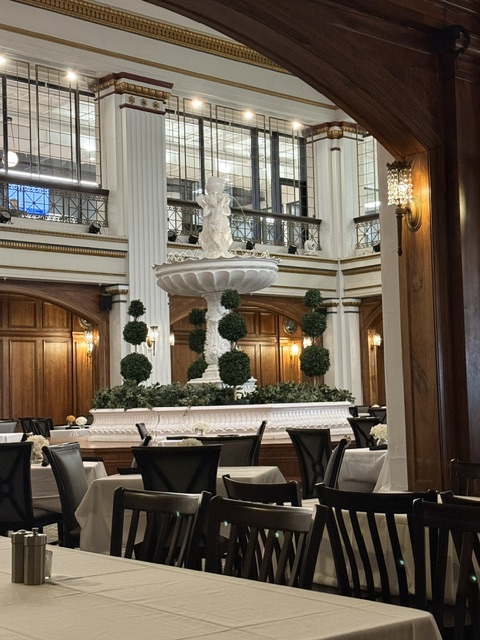

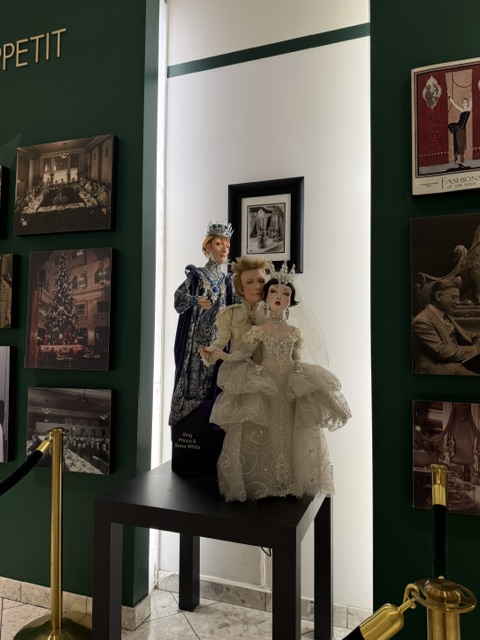
Beyond the seasonal tributes, the upper-floor customer service area has long maintained a set of history panels tracing the Field family’s story and the store’s many retail innovations, well worth a detour even on a quick visit. Together with the Tiffany dome and the Walnut Room, they make the building less a department store you happen to walk through and more of a working museum of Chicago commercial history that also happens to sell perfume.
Worth the Detour
I’d recommend this stop to absolutely anyone with an appreciation for decorative arts or Chicago history, shopping list or not. Between Tiffany’s largest surviving mosaic and a department store that essentially invented the modern shopping experience, it’s a remarkable amount of cultural weight to find tucked into a single building on State Street — and it’s free simply to walk in and look up.
Lisa’s Take
Some of my favorite travel discoveries aren’t the attractions splashed across guidebooks—they’re the places recommended by someone who knows a city well. Our hotel concierge suggested we stop by Marshall Field’s—yes, most people still think of it as Marshall Field’s—and I’m so glad we listened. Standing beneath Tiffany’s extraordinary dome reminded me that some of the world’s finest works of art aren’t always found in museums. Sometimes they’re hiding in department stores, hotel lobbies, train stations, or libraries, quietly waiting for someone to look up. Those unexpected discoveries often become the memories we treasure most.
For the rest of where we stayed, ate, and explored on this trip, look for the complete Insider’s Guide to Chicago – coming soon. In the meantime, stay tuned for the next post in this Chicago series.